
Polyaspartic Garage Floor Coating in Carlsbad
Epoxy Floors Shore Carlsbad covers polyaspartic and polyurea garage floor coatings in Carlsbad — the fast-curing systems sold as one-day floors — for garages with an open door and afternoon sun, with the cure stages, the odor and the trade-offs spelled out before the price.

Bookings aren't open yet. Leave your name and number; your message is recorded, and you'll get one message when a local installer is available.
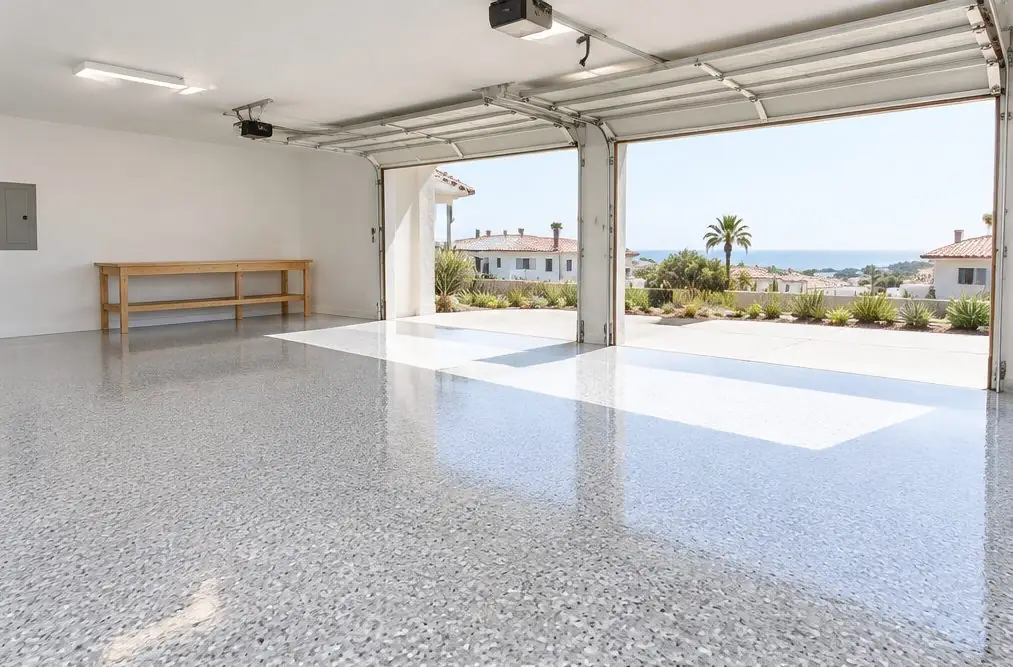 Illustration
Polyaspartic, polyurea and what the words mean
Polyurea is a family of fast-reacting coatings. Polyaspartic is one member of that family, formulated to give the installer a little more working time than a straight polyurea. In a garage the two names are used almost interchangeably, and what matters is the data sheet of the specific product.
Two layouts are common:
- Hybrid. An epoxy base coat carries the flake, and a thin polyaspartic top coat seals it. This is the layout the estimator prices at $6–$10 per square foot.
- Polyaspartic throughout. A polyaspartic primer, base and top coat. It cures fastest and costs most at the high end of the range, and it asks the most of the slab and the installer.
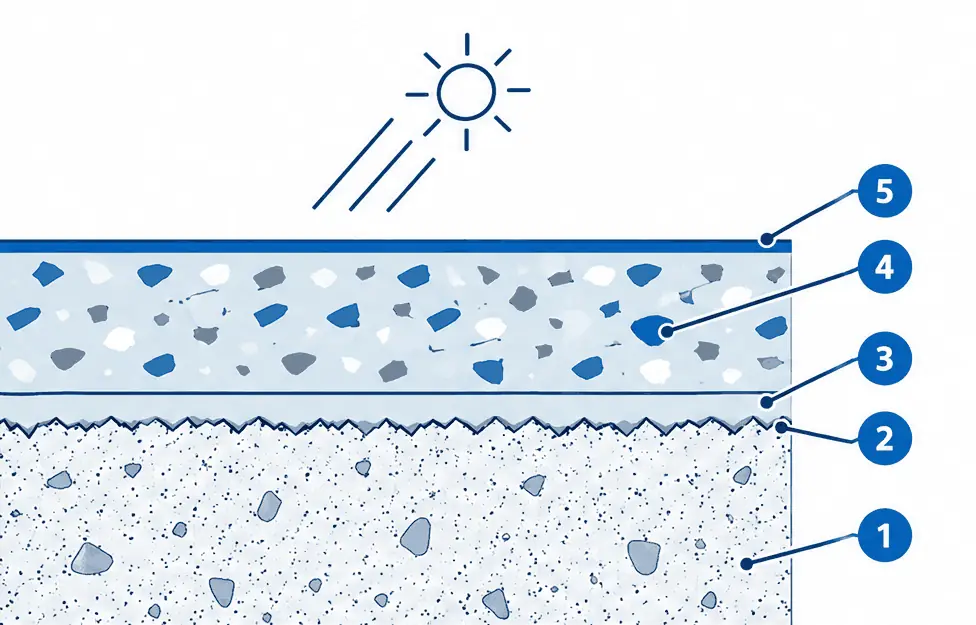
What the numbers show
- Concrete slab The slab is ground and tested for moisture before anything goes on it.
- Ground surface The opened surface gives the epoxy primer a profile to grip.
- Epoxy primer and base Epoxy bonds well to the ground slab and has a longer working time, so the flake can be broadcast into it.
- Flake Color chips embedded in the base for texture and for hiding small flaws in the slab.
- Polyaspartic top coat A thin, fast-curing layer that is generally more UV-stable than epoxy; it covers the flake and is the surface that meets sun and tires.
What «one day» really means
Many polyaspartic systems can be installed in one day. That does not mean the floor is ready for anything by evening. Cure comes in stages, and the data sheet of the product names the times.
| Stage | What it means | What to expect |
|---|---|---|
| Installed | Primer, base, flake and top coat are down | Often one day for a two-car garage |
| Foot traffic | Walking in clean socks or soft shoes | Usually the next day |
| Light use | Bikes, shelving, light loads | After the time on the data sheet |
| Vehicles | A car or a truck on the floor | Often 24 hours to several days, by product, temperature and humidity |
| Full chemical cure | Cleaners, oils and brake fluid | Longer than the first week; the data sheet names it |
The floor is not ready the moment the installer leaves. Ask for the vehicle date in writing and park outside until it passes.
Odor, pot life and what owners report
Polyaspartic cures quickly, and the working time is short, especially in warm weather. An installer has minutes, not hours, to roll and broadcast before the product starts to set. In a cool, humid Carlsbad morning the working time stretches; in a Santa Ana afternoon it shrinks, so the start time matters.
Some systems have a strong odor while they cure. The garage is ventilated, and people and pets stay out until the data sheet says otherwise. Owners in garage forums report odor lasting longer than expected after some jobs, so ask which product is used and how the odor is handled where the garage shares a wall with living space.
The honest trade-offs
| Polyaspartic top coat | Epoxy top coat | |
|---|---|---|
| Sunlight | Generally more UV-stable | Can amber, noticeable with the door open |
| Return to service | Short for a car | Often several days |
| Working time | Short | Longer |
| Price | Higher per square foot | Lower |
| Slab sensitivity | Needs a dry, well-ground slab | Same |
The honest summary is that polyaspartic is a good choice for a bright garage with a door that stays open, and a poor choice if the slab is damp or the installer is rushing.
Hot tires and the open door
Hot-tire pickup, where a warm tire lifts the coating, is mostly a prep and product problem. A ground slab and a system rated for it reduce the risk. Polyaspartic top coats are generally more UV-stable than epoxy, so they are the usual choice where the door faces the afternoon sun and stays open.
Polyaspartic Garage Floors — common questions
Is polyaspartic better than epoxy?
Not across the board. It is generally more UV-stable and cures faster, while epoxy is a good base that gives the installer more working time. Many garages use both layers.
When can a car go back on a polyaspartic floor?
After the time on the product's data sheet, often 24 hours to several days depending on the product, temperature and humidity. The installer names the date.
Polyaspartic Garage Floors: check availability and price range
Bookings aren't open yet — a typical Carlsbad range in about 30 seconds.