
Garage Floor Prep, Grinding and Crack Repair in Carlsbad
Epoxy Floors Shore Carlsbad covers concrete prep for Carlsbad garage floors — diamond grinding, crack and spall repair, and moisture testing — which together decide whether a coating stays down, and which most quotes bury in one line.

Bookings aren't open yet. Leave your name and number; your message is recorded, and you'll get one message when a local installer is available.
 Illustration
Why prep decides the result
A coating bonds to the surface the installer gives it. Smooth, oily or damp concrete does not offer much to bond to, and most peeling starts there. Prep is the largest labor item in a coating job and the one that is easiest to shorten.
Garage floors in Carlsbad's 1980s–2000s master-planned neighborhoods are often smooth-troweled slabs with a curing compound still on top, and older coastal garages may hold decades of oil. In both cases the first task is to open the surface.
Etching or grinding
| Acid etching | Diamond grinding | |
|---|---|---|
| How it works | Acid dissolves the cement paste at the surface | A grinder with diamond segments cuts the surface open |
| Surface profile | Light and uneven | Even, with a profile the coating can grip |
| Removes old coating and sealer | No | Yes |
| Dust and waste | Rinse water and acid residue | Dust, collected by a shroud and a vacuum |
| Damp slab behavior | Unpredictable near the coast | Opens the surface, but does not dry the slab |
| Use | Weaker substitute | The usual choice for resin coatings |
The standard that professionals use for roughness is the Concrete Surface Profile scale of the International Concrete Repair Institute; a coating's data sheet names the profile it needs. Ask what profile the grinding aims for and which grinder is used.
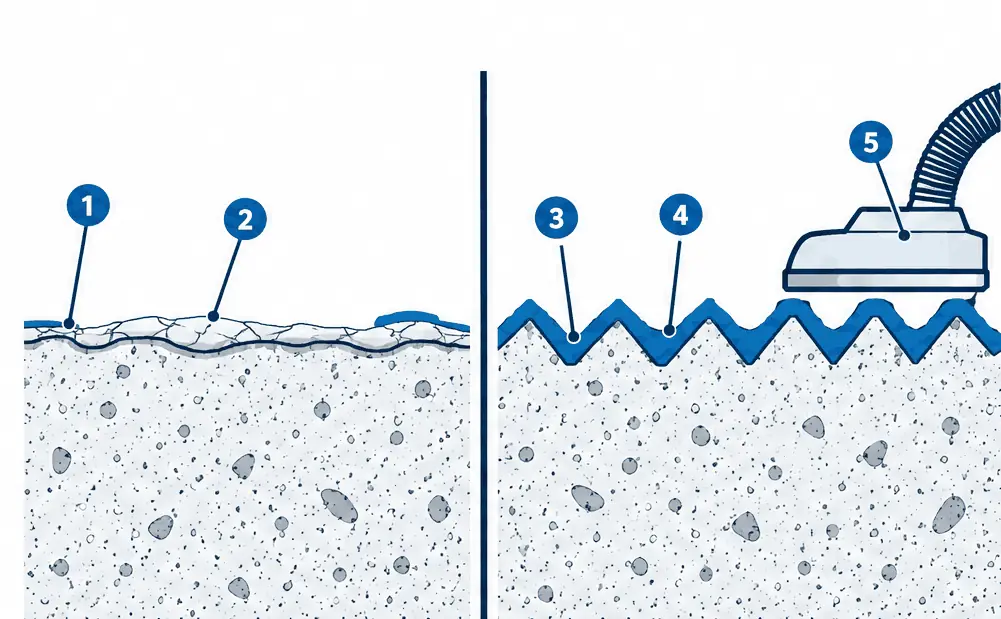
What the numbers show
- Etched surface Acid dissolves the cement paste at the top and leaves a shallow, uneven profile.
- Loose surface layer A weak film of paste can stay on an etched slab and let go under the coating.
- Ground surface A diamond grinder cuts an even, rough profile into sound concrete.
- Coating in the profile The first coat flows into the peaks and valleys and grips them.
- Dust control Grinding makes dust, so the grinder carries a shroud and a vacuum hose.
Three ways to test for moisture
A slab with moisture vapor rising through it can push a coating off, and near the coast many slabs carry more than owners expect.
| Test | How it works | When it is used |
|---|---|---|
| Plastic sheet | A square of plastic is taped to the slab for 24 to 72 hours | A quick first look; shows condensation under the sheet |
| Calcium chloride (ASTM F1869) | A dish of chloride is sealed under a dome for about 60 to 72 hours | Measures vapor leaving the slab |
| In-slab relative humidity probes (ASTM F2170) | Probes sit in drilled holes in the slab | The more thorough reading; takes a day |
Where readings are high, a moisture-mitigating primer is used, or the job is reconsidered. A test is a small cost compared with a floor that lifts.
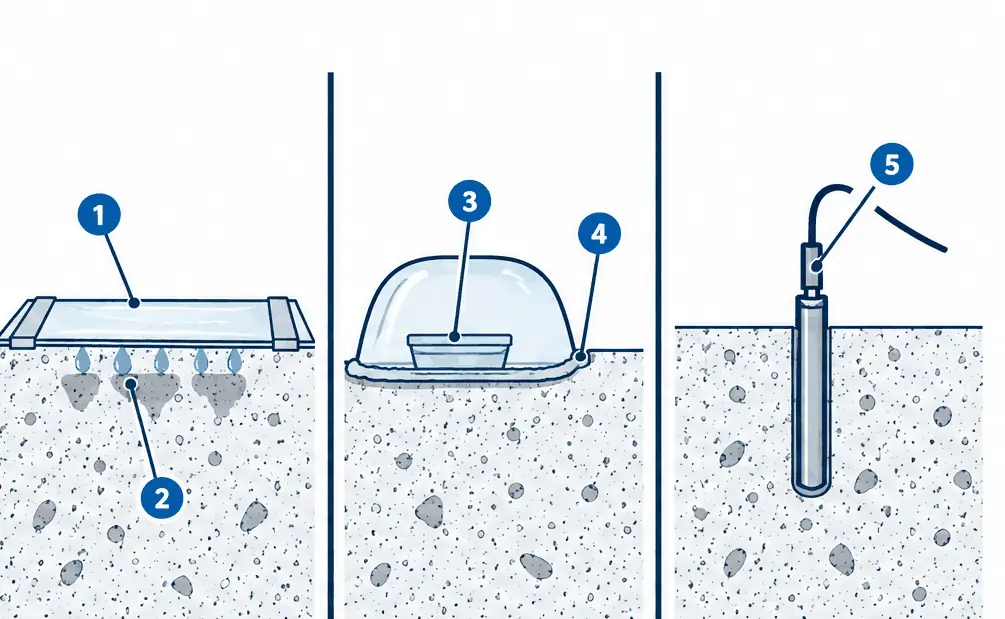
What the numbers show
- Plastic sheet A square of plastic is taped down on all four edges for a day or more.
- Condensation Drops or darkening on the slab under the sheet show moisture rising; it is a first look, not a number.
- Calcium chloride dish A dish of salt is weighed, sealed under a dome and weighed again after about three days; the gain measures the vapor leaving.
- Sealed dome rim The dome is sealed to the slab so only the slab's vapor reaches the dish.
- In-slab humidity probe A sleeve sits in a drilled hole, and a probe inside reads the relative humidity of the concrete after the hole has equalized.
Cracks, joints and spalls
| Defect | What it is | Typical repair | What to expect |
|---|---|---|---|
| Hairline crack | A thin shrinkage crack | Routed, filled and ground flush | Often stays closed |
| Control joint | A saw cut meant to let concrete crack in a line | Cleaned and filled with a flexible joint filler | A flexible fill moves with the slab |
| Spall or pit | Chipped or pocked surface | Patched with repair mortar | Smooth after grinding |
| Moving or stepped crack | One side higher or sliding | Filled, and the movement watched | May reflect through the coating |
A rigid coating over a moving crack can crack with it. A repair is a reasonable fix, not a promise that the crack will not come back.
What prep adds to the price
The estimator's slab condition lines show the extra per square foot over a sound slab with standard grinding: minor cracks, pitting or small spalls add $1–$2, an old coating to remove adds $1–$3, and a damp or oil-soaked slab adds $2–$4. On a 440-square-foot garage that is about $440–$880 for cracks and pitting. A written quote should list these lines separately so they can be compared.
Garage Floor Prep and Crack Repair — common questions
Is acid etching enough for a garage floor?
It is a weaker substitute for grinding. Professionals who coat with resin systems grind, and a quote that says only «etch» deserves a question.
How do I know if my garage slab is damp?
A plastic sheet taped down for a day or two is a first look. A calcium chloride test or in-slab humidity probes give a number; many installers run one before coating.
Garage Floor Prep and Crack Repair: check availability and price range
Bookings aren't open yet — a typical Carlsbad range in about 30 seconds.