
Flake Epoxy Garage Floors in Carlsbad
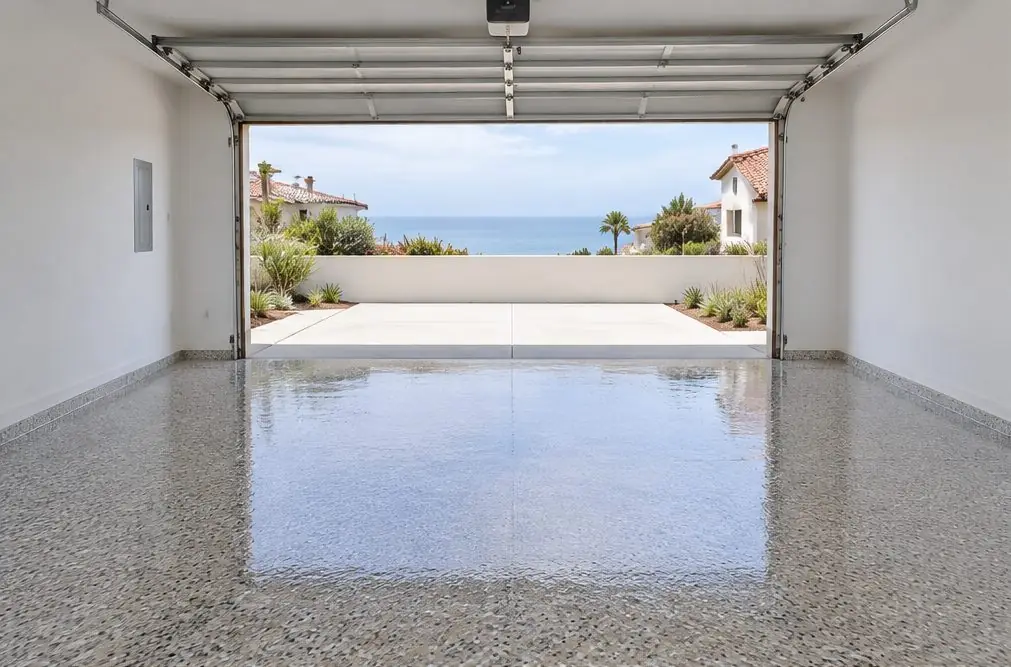
Epoxy Floors Shore Carlsbad covers flake (chip) epoxy garage floors across Carlsbad — the speckled, textured finish that hides small slab flaws — in La Costa two-car garages, coastal bungalow garages and three-car garages alike, with the slab ground, checked for moisture and sealed under a clear top coat.

Bookings aren't open yet. Leave your name and number; your message is recorded, and you'll get one message when a local installer is available.
 Illustration
The stack, layer by layer
A flake floor is not a coat of paint. It is a stack of layers, and the order is what keeps it down.
- Ground slab. A diamond grinder opens the concrete surface so the first coat can grip it.
- Primer. A thin coat that soaks into the opened surface.
- Epoxy base coat. A 100%-solids epoxy rolled over the primer while it is still wet.
- Flake. Colored vinyl chips are thrown by hand into the wet base until the floor is covered.
- Scrape and sweep. Once the base has cured, loose flake is scraped and swept away.
- Clear top coat. One or two clear coats lock the flake in and give the floor its gloss and wear layer.
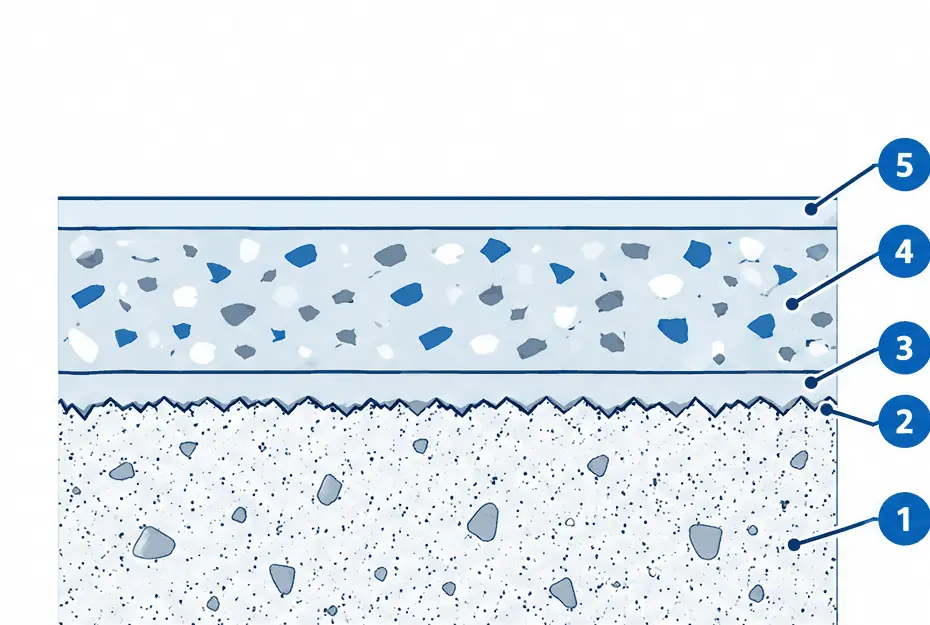
What the numbers show
- Concrete slab The garage slab carries everything; the coating sits on it and does not strengthen it.
- Ground surface A diamond grinder cuts the top of the slab open into a rough, even profile the first coat can grip.
- Primer A thin coat that soaks into the opened surface and gives the base coat something to bond to.
- Epoxy base with flake The 100%-solids epoxy is rolled on, and color flakes are thrown into it while it is wet, so they sit embedded with their tops showing.
- Clear top coat One or two clear coats cover the flake edges, lock the chips in and form the wear layer.
Full broadcast or partial
How much flake goes in decides the look, how well the floor hides flaws and what the estimate says.
| Full broadcast | Partial broadcast | |
|---|---|---|
| Look | Solid carpet of color; the base barely shows | Scattered chips over a visible base color |
| Hides small pits and patches | Best | Less, the base shows through |
| Texture underfoot | Noticeably grippier | Smoother, easier to wipe |
| Material used | More flake, more top coat | Less flake |
| Where it fits | Garages that take a beating and need a forgiving surface | Showroom-style garages and lighter use |
The estimator on this page prices full broadcast. A quote for a partial broadcast should say so on its own line, because the buyer is comparing different amounts of material.
Picking colors without a showroom
Flake comes in small, medium and large chips, in single colors and blends. Chip size matters more than most people expect: small chips read as a fine speckle from the driveway, large chips read as a bold pattern.
- Light blends hide dust and tire dust but show oil drips.
- Dark blends hide oil and show dust and footprints from a gray slab.
- Mid-gray and tan blends are the middle path and photograph well under garage lights.
- A contrasting base color shows through gaps in a partial broadcast, so it is chosen with the flake.
The color chooser on this page draws an on-screen approximation using generic color names. Ask for a physical sample board before choosing: screens and garage lights both change color.
Damp mornings and a coastal slab
Carlsbad's summers start gray. The marine layer forms earliest and lasts longest at the coast and clears from mid-morning to early afternoon, which leaves the air humid and the slab cool in the hours an installer would like to coat. Near the coast, damp air slows curing, and a slab that stays damp can push a coating off.
Installers watch the dew point and the slab temperature before they mix, and many test the slab first (the prep page explains the three common tests). Where readings are high, a moisture-mitigating primer goes down, or the job is reconsidered. A flake floor installed on a damp slab can look fine for months and then lift.
What a flake floor costs by garage size
Typical Carlsbad ranges for full-broadcast flake on a sound slab, from the estimator ($5–$8 per square foot):
| Garage | Typical size | Floor total |
|---|---|---|
| 1-car | 240 sq ft | $1,200–$1,920 |
| 2-car | 440 sq ft | $2,200–$3,520 |
| 3-car | 700 sq ft | $3,500–$5,600 |
Cracks or pitting add $1–$2 per square foot, an old coating to remove adds $1–$3, and a damp or oil-soaked slab adds $2–$4. A stem wall or entry steps are flat add-ons. These are market estimates, not quotes.
Four lines to check on a flake quote
Four lines separate a flake floor that lasts from one that peels: how the slab is prepared (grinding, not just etching), how many mils of coating go down, whether flake coverage is full or partial, and which top coat is used. Ask for each in writing and compare them quote against quote; the full checklist is in the guide below.
Flake Epoxy Garage Floors — common questions
How much flake epoxy do you need on a two-car garage?
A two-car garage in San Diego County is commonly 400 to 480 square feet, so a full broadcast uses enough flake to cover that area with a little to spare. The quote should name the amount and the coverage.
Can flake epoxy go on a floor that has an oil stain?
Only after the oil is dealt with. Oil that is left in the slab can break the bond, so degreasing and grinding come before any coating, and a slab that is heavily soaked is priced on the oil and moisture line.
Flake Epoxy Garage Floors: check availability and price range
Bookings aren't open yet — a typical Carlsbad range in about 30 seconds.