
Worked case: a three-car polyaspartic flake garage in Aviara — what happens and what it costs
Epoxy Floors Shore Carlsbad walks through a typical job for a three-car garage in Aviara: a 700-square-foot sound builder slab, an epoxy base with flake and a polyaspartic top coat, a custom blend chosen to match the cabinets, and the cure stages laid out before the day begins.
Bookings aren't open yet. Leave your name and number; your message is recorded, and you'll get one message when a local installer is available.
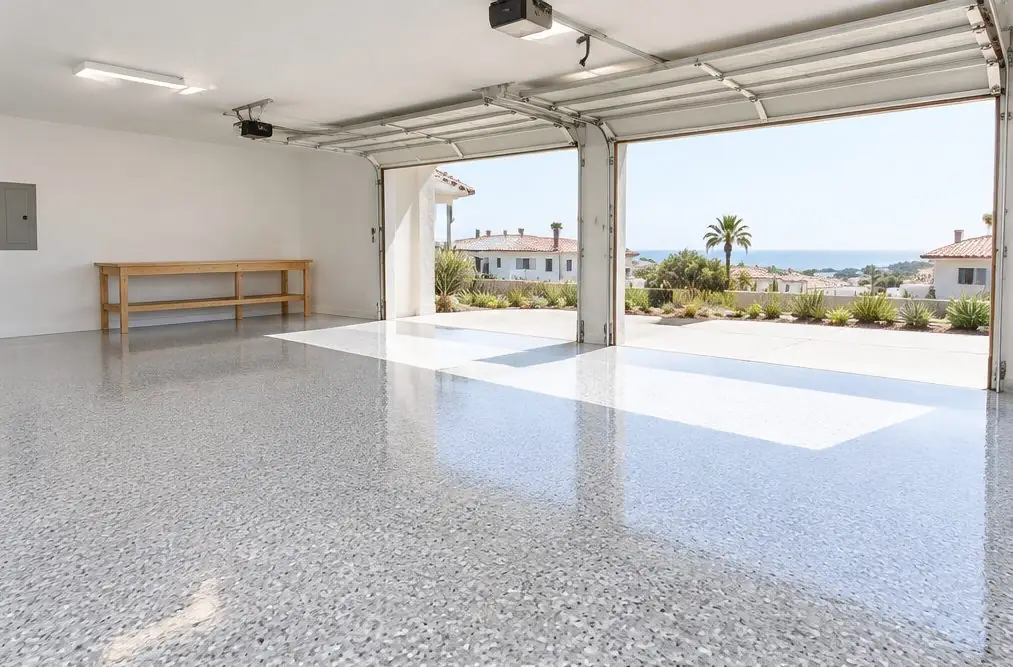
Worked example. The pictures are AI concept illustrations, not photographs; no installation was performed or arranged through this site; prices are typical Carlsbad area market ranges, not quotes.
 Illustration
Project Examples & Typical Prices
The scenario
Picture a three-car garage in a hillside home above the lagoon, about 32 by 22 feet, which is roughly 700 square feet. The slab is a builder-grade floor, smooth-troweled and sound, with a few hairline cracks and no old coating. The garage has white cabinets along the back wall, a workbench, and a door that faces afternoon sun and stays up when the family is in the driveway. The community's design council has rules about visible changes, and the owner has sent a short note about the dates and the contractor's truck.
The owner wants a floor that handles hot tires and stays clear under the sun. A polyaspartic top coat is generally more UV-stable than epoxy and cures faster, which fits a bright, open garage. The question is not whether it is possible to finish in a day, but what the cure stages mean for the week.
The starting conditions at a glance:
- Size: three-car garage, about 700 square feet
- Slab: sound builder slab with smooth trowel finish and a curing compound still on top
- System: epoxy base with a custom flake blend and a polyaspartic top coat
- Setting: a hillside coastal home, door facing afternoon sun, an association with design rules
What the job involves
- A moisture check is run first, since hillside coastal slabs can be damp; a calcium chloride test or in-slab probes give the reading that decides whether a primer is needed.
- A diamond grinder with a vacuum removes the curing compound and opens the surface; hairline cracks are filled and ground flush.
- The installer checks the dew point and the slab temperature and picks a start time after the gray lifts, because the polyaspartic top coat has a short working time.
- Primer and an epoxy base coat go on in sections, and the flake blend is broadcast by hand across the wet base until the floor is covered.
- After the base has cured, loose flake is scraped and swept, and the polyaspartic top coat is mixed in small batches and rolled quickly in sections.
- Ventilation runs while the top coat cures, and the installer names the day for foot traffic and the day for the vehicles from the data sheet.
Materials and prep
- Diamond grinder with dust shroud and vacuum
- Moisture test supplies: calcium chloride kit or in-slab humidity probes
- Epoxy primer and epoxy base, vinyl flake in a custom blend and a polyaspartic top coat
- Rollers in several widths, squeegees, a flake bucket, spiked shoes and fans
- A thermometer and a dew point meter for the start time
What it typically costs in the Carlsbad area
| Polyaspartic flake (epoxy base, polyaspartic top coat), 700 square feet installed ($6–$10 per sq ft) | $4,200–$7,000 |
| Move the garage contents out and back | +$150–$400 |
| Custom flake blend | +$100–$300 |
| Typical total | $4,450–$7,700 (market range, not a quote) |
These are typical local ranges, not a quote or an offer; an installer prices the actual job after seeing the floor.
Add-ons often paired with this job
- Coat the stem wall (the low wall around the garage) — +$150–$400. A coated stem wall gives the room a finished edge.
- Coat the entry steps or landing — +$100–$300. The entry steps from the house are coated in the same system.
Why it is done this way
The hybrid layout is chosen because each layer does what it is good at. Epoxy bonds well to a ground slab and gives the installer time to broadcast flake while the base is wet. A polyaspartic top coat is generally more UV-stable and cures faster, which is the reason to pay $6–$10 per square foot instead of $5–$8.
The honest part of the story is the cure. Many polyaspartic systems can be installed in one day, and foot traffic usually resumes the next day. Vehicles come back after the time on the product's data sheet, often 24 hours to several days depending on the product, temperature and humidity. Parking outside until that date is part of the plan.
The working time is short, so the start time matters. On a cool, damp coastal morning the product has more time than on a hot afternoon when Santa Ana winds blow. Starting after the gray lifts and before the heat peaks keeps the work in the middle.
The association note is part of the job even though the floor is inside the garage. The door stays open and the installer's truck is at the curb, and the council's documents decide what applies.
The alternatives that were weighed and set aside:
- Epoxy throughout would cost $5–$8 per square foot but can amber in sunlight at an open door.
- Polyaspartic throughout is possible and asks more of the slab and the installer for a small gain in this setting.
What would change the price
- Cracks or an old coating add $1–$3 per square foot and scale with the area.
- A damp slab needs the moisture line of $2–$4 per square foot.
- A larger or smaller garage changes the area, and every line scales with it.
- A cure window that overlaps a cool, damp week can move the start date.
- Stem walls, steps and extra crack repair are flat add-ons.
Where this leads
- Service page: Polyaspartic Garage Floors — A fast-curing, UV-stable top coat over an epoxy base, with the cure timeline and the downsides spelled out.
- Local page: Epoxy garage floors in Aviara
- All services and typical prices: epoxy garage floors in Carlsbad
- More worked examples: Project Examples & Typical Prices
Check availability and the price range for this setup
Bookings aren't open yet — a typical Carlsbad range in about 30 seconds.