
Worked case: a 3,000-square-foot warehouse aisle in a business park near the research center, striped and joint-filled — what happens and what it costs
Epoxy Floors Shore Carlsbad walks through a typical job for a 3,000-square-foot warehouse aisle in a business park near the Carlsbad Research Center: a smooth slab with saw-cut joints and cracks, solid-color epoxy with grit, joints filled, aisles striped and the work phased around deliveries.
Bookings aren't open yet. Leave your name and number; your message is recorded, and you'll get one message when a local installer is available.
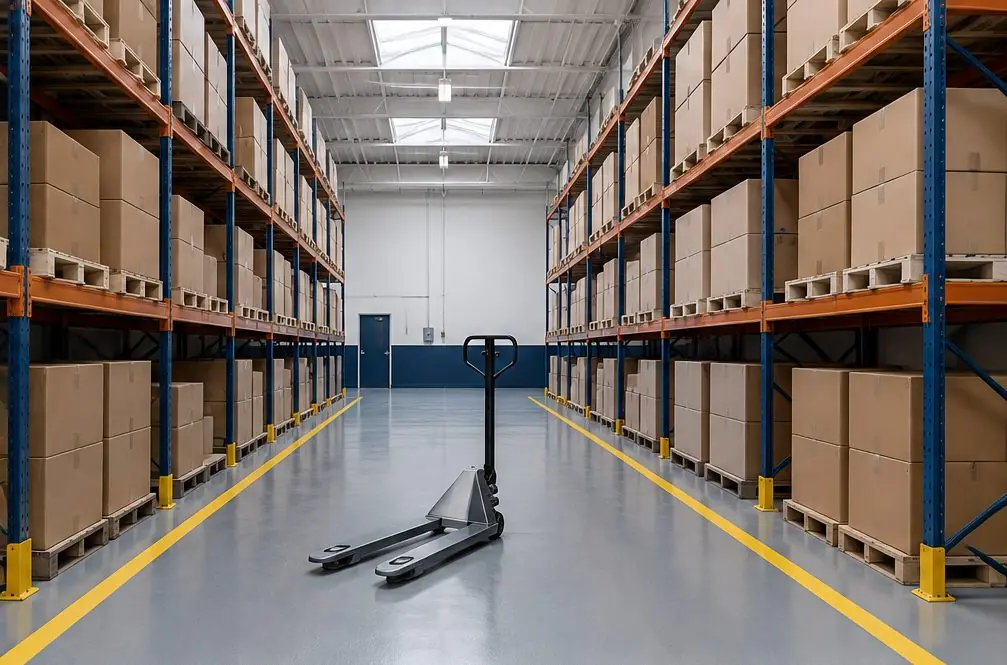
Worked example. The pictures are AI concept illustrations, not photographs; no installation was performed or arranged through this site; prices are typical Carlsbad area market ranges, not quotes.
 Illustration
Project Examples & Typical Prices
The scenario
Picture a flex unit in a Carlsbad business park: a front office, a warehouse behind it and a roll-up door to a loading apron. The warehouse floor is about 3,000 square feet of slab-on-grade, cut with control joints every dozen feet or so, and holds racking in two rows with a central aisle. Pallet jacks and a small electric stacker are the heaviest things that roll on it. The concrete is dusty, a few joints have chipped edges and some hairline cracks run from the corners of the racking.
The business ships every weekday and cannot close. The owner wants a floor that sweeps clean, takes striping for the aisles and does not dust the stock, and wants it done in phases so a loading lane stays open.
The starting conditions at a glance:
- Size: about 3,000 square feet of slab
- Slab: slab-on-grade with saw-cut control joints, some chipped edges and hairline cracks, curing compound still on top
- System: solid-color epoxy with grit
- Schedule: phased by aisle; weekends and early mornings
What the job involves
- A zone plan on paper numbers the aisles and keeps the loading lane open; the business moves its own stock from one zone to the next.
- A grinder with a vacuum takes the curing compound off one zone at a time, and a first moisture reading is taken in the opening zone.
- Hairline cracks are routed and filled, and chipped joint edges are rebuilt with repair mortar.
- The saw cuts are blown clean and filled with a semi-rigid material, then a primer and pigmented 100%-solids epoxy are rolled over the zone.
- The coating is cut along every joint so the slab can move, and a gritty clear top coat is rolled over the color for traction under pallet jacks.
- After the cure time on the data sheet, a chalk line lays out aisles and walkways, the stripes go on and the racking stock returns.
Materials and prep
- A planetary grinder, an edge grinder and an industrial dust vacuum
- Flexible joint filler and a repair mortar for chipped edges
- Epoxy primer, pigmented 100%-solids epoxy and a clear top coat with grit
- Notched squeegees, rollers, spiked shoes and fans
- Striping tape or paint, a chalk line and a layout wheel
What it typically costs in the Carlsbad area
| Solid-color epoxy with grit, 3,000 square feet installed ($3–$7 per sq ft) | $9,000–$21,000 |
| Cracks, joints or spalls to repair (+$1–$3 per sq ft) | +$3,000–$9,000 |
| Line striping and safety markings | +$300–$900 |
| Joint filling (saw cuts and control joints) | +$400–$1,200 |
| Typical total | $12,700–$32,100 (market range, not a quote) |
These are typical local ranges, not a quote or an offer; an installer prices the actual job after seeing the floor.
Add-ons often paired with this job
- Cove base up to 100 linear feet — +$1,500–$2,500. A coved base can be added at the walls of the office zone.
Why it is done this way
Solid color with grit is the right level for aisles with pallet jacks and light stackers. It seals the dust, takes striping and costs the least of the commercial systems at $3–$7 per square foot. A heavier system, such as quartz broadcast, is for forklifts with hard wheels turning in the same spot.
Joints decide how long the floor looks good. A rigid coating bridges a saw cut badly, so the cuts are cleaned and filled with a flexible filler first, and the coating is cut over them so the slab can move. Skipped joint work often shows up as a line of cracking above each saw cut.
The phasing is what makes the job fit the business. A planned order, with stock moves and return dates for each zone taken from the data sheet, lets the shipping door stay open. The schedule option in the estimator is a flag for the contractor and does not change the range.
Polished concrete was considered. It grinds and hardens the slab itself and controls dust well, but it resists oil less and shows aggregate. For a floor that will see spills and take striping, a coating fits better.
The alternatives that were weighed and set aside:
- Quartz broadcast at $8–$15 per square foot is stronger under hard wheels and rougher to clean.
- A sealer only would be cheaper and would not take striping the same way.
What would change the price
- Aisles stained by leaking pallets or a slab that tests damp take the moisture line.
- A floor that already carries mastic or an old coating needs removal before this range applies.
- Hard-wheeled forklifts turning in the same spot point to quartz broadcast.
- A tighter joint spacing than the plan assumed means more filling.
- Racking that cannot move at all stretches the schedule.
Where this leads
- Service page: Warehouse Floor Coating — Aisle, dock and lane coatings for warehouse and flex space, with joint filling, striping and a comparison with polished concrete.
- Local page: Epoxy garage floors in Carlsbad Research Center
- All services and typical prices: epoxy garage floors in Carlsbad
- More worked examples: Project Examples & Typical Prices
Check availability and the price range for this setup
Bookings aren't open yet — a typical Carlsbad range in about 30 seconds.