
Epoxy vs Polyaspartic vs Polyurea: Which Garage Floor Coating Fits?
Epoxy Floors Shore Carlsbad compares epoxy, polyaspartic, polyurea and hybrid garage floor coatings side by side, explains how the names relate, and shows which trade-offs matter for a coastal Carlsbad garage.
Bookings aren't open yet. Leave your name and number; your message is recorded, and you'll get one message when a local installer is available.
The floor as it starts
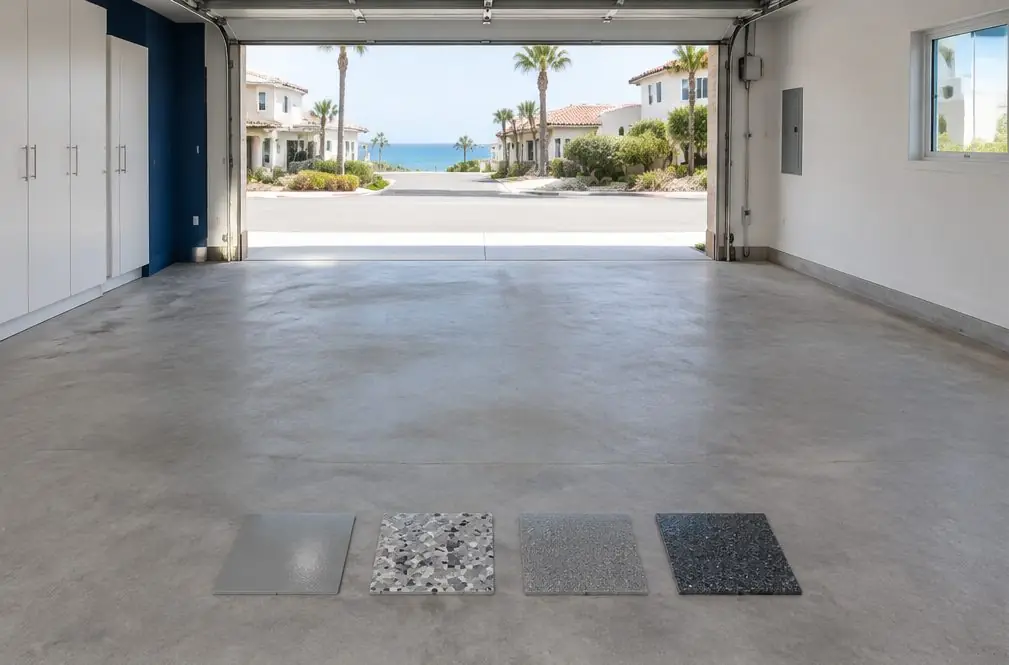 Illustration
The finished floor (illustration)
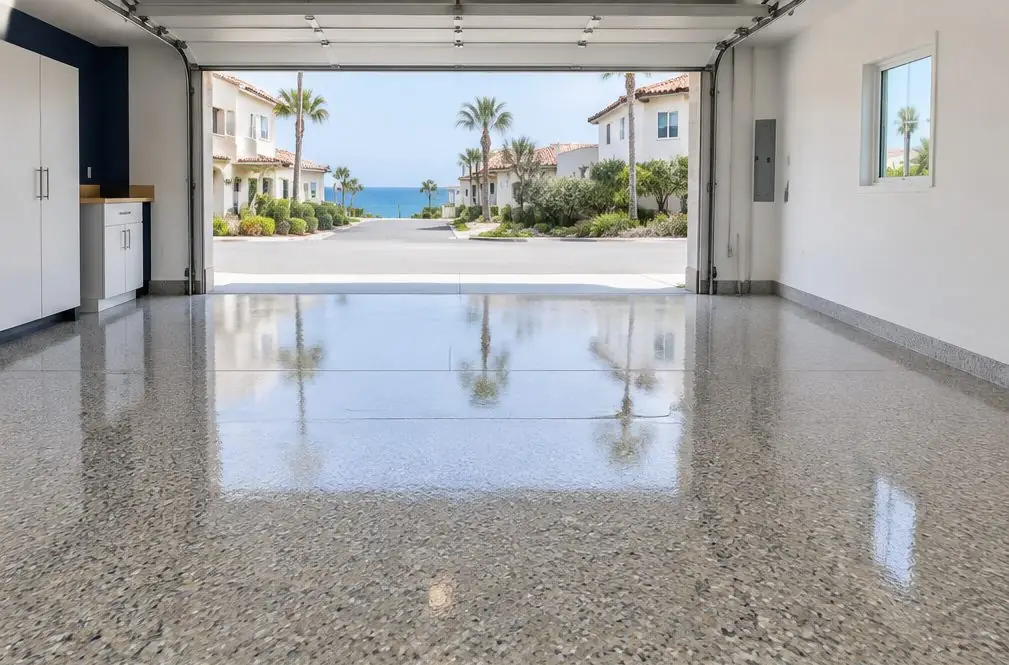 Illustration
Three names, two chemistries
The words in this debate get tangled, so it helps to untangle them first. Epoxy is a two-part resin that is mixed on site and cures into a hard film. Polyurea is a different resin family that cures very fast. Polyaspartic is a kind of polyurea: a slower-reacting version designed so an installer has a few minutes of working time instead of seconds. When a sales page contrasts "polyaspartic" with "polyurea", it is usually describing two points on the same family tree.
A fourth term is the one most garages actually get: the hybrid. An epoxy base coat is rolled onto the ground slab, flake is broadcast into it, and a polyaspartic or polyurethane top coat finishes the surface. The base does the bonding and filling; the top coat does the sunlight and scuff resistance.
Side-by-side comparison
The table keeps to general tendencies. Product data sheets differ, and a specific system can sit outside these patterns.
| Epoxy | Polyaspartic | Polyurea | Hybrid (epoxy base, polyaspartic top) | |
|---|---|---|---|---|
| Sunlight and yellowing | Can amber with long sun exposure | Generally more UV-stable | Aliphatic types are generally more UV-stable | Top coat protects the epoxy underneath |
| Install speed | Often several days before a car | Many systems install in a day | Fast cure, short working time | Often one to two days |
| Cure odor | Moderate to strong while curing | Can be strong while curing | Strong while curing | Strong during the top coat |
| Sensitivity to slab moisture | High: vapor can lift it | High: can bubble if damp when applied | High | High, but the epoxy base can be paired with a moisture primer |
| Market band, per sq ft | Flake 5–8, solid 3–6 | Not priced separately in the estimator | Not priced separately in the estimator | 6–10 |
| Typical failure | Peeling over a damp or poorly ground slab, yellowing at the door | Bubbles or pinholes from damp slab or heat during application | Poor bond from short working time | Delamination between layers if the base was not prepped |
Every band is a market estimate, not a quote.
Where each one makes sense
Epoxy alone. Epoxy has a long working time and bonds well to a properly ground slab, which is why it is the common base coat. As a stand-alone solid color in a garage with the door mostly closed, it is the lowest-cost route to a clean, sealed surface. The compromise is slow return to service and some amber tinting where sunlight hits it daily.
Full polyaspartic or polyurea. The appeal is speed and sunlight stability. The compromise is a short pot life: the installer mixes small batches and moves quickly, so the result depends heavily on the crew's rhythm and on slab temperature. Cool, damp coastal mornings matter here.
Hybrid. It is the usual choice when a household wants flake and a garage door that stays open. It is priced above flake epoxy because it adds a top coat and a more careful prep schedule.
Questions that separate good quotes from vague ones
Brand names matter less than what is written on the quote. Useful questions:
- Is the slab diamond ground, and is acid etching being offered as a substitute?
- Is the slab tested for moisture, and what happens if the reading is high?
- What is the film thickness of each coat, and how many coats go down?
- Which layer is epoxy and which is polyaspartic or polyurethane?
- When can feet, then wheels, return, according to the data sheet?
- Ask what the warranty covers: peeling, hot-tire pickup and yellowing, for how long, and whether the prep is part of it.
Answers that are specific beat answers that are confident. A reply of "everything is included" says nothing about any of the above.
Picking for a Carlsbad garage
Near the coast, damp air slows curing and can raise slab moisture, so installers watch the dew point and slab temperature before coating. That affects every system in the table, and it affects fast-cure systems most, because they leave little room to wait.
A simple way to decide: if the door stays closed and budget leads, a solid color or flake epoxy is a reasonable answer. If the door is open often, or the floor will be seen from the driveway, a hybrid top coat is worth pricing. If a household wants the fastest return to service, a full polyaspartic system is worth asking about, with the moisture questions above answered in writing.
The estimator on the parent page turns any of these into a market range for a specific garage size and slab condition. It is an estimate, not a quote, and a local coating installer sets the real figure after seeing the slab.
Where this leads
- Service page: Polyaspartic Garage Floors — A fast-curing, UV-stable top coat over an epoxy base, with the cure timeline and the downsides spelled out.
- All services and typical prices: epoxy garage floors in Carlsbad
- More illustrated guides: Epoxy Floor Guides
Check availability and the price range for this setup
Bookings aren't open yet — a typical Carlsbad range in about 30 seconds.